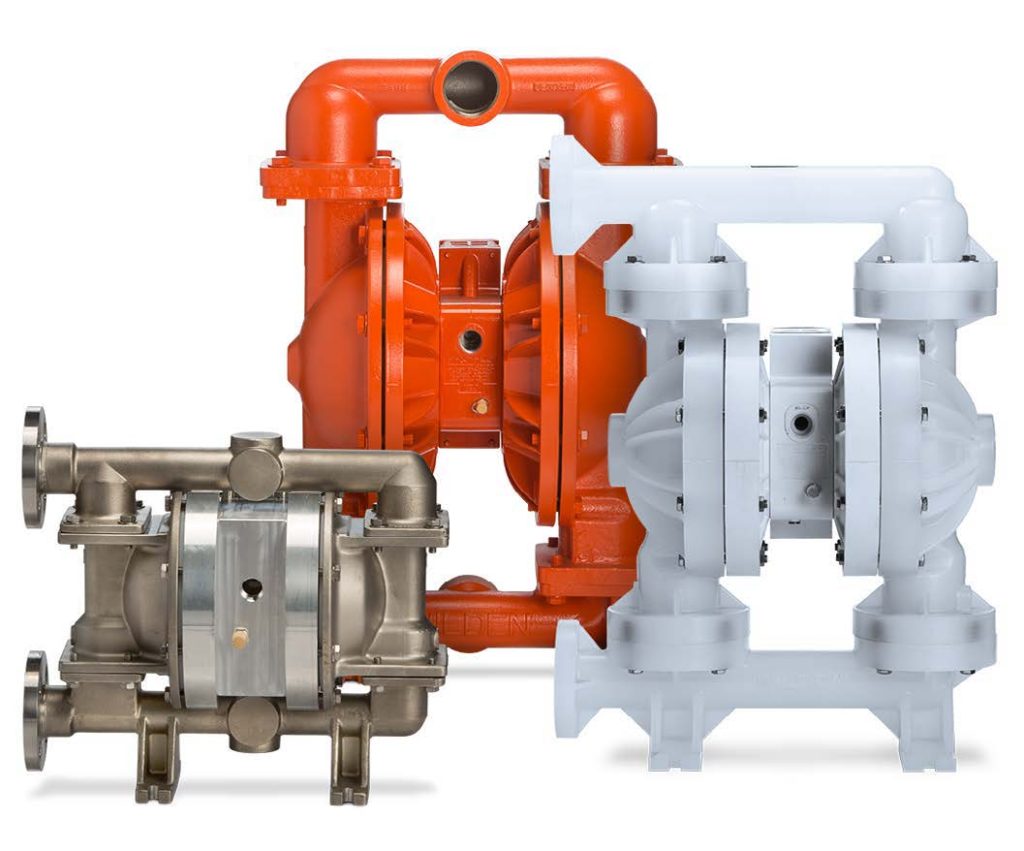
Air-operated diaphragm pumps drive fluid transfer in mining operations, chemical plants, and manufacturing facilities. These pneumatic diaphragm pumps handle abrasive slurries, corrosive acids, and shear-sensitive fluids that destroy conventional pumps. Their compressed air power source eliminates electrical hazards in explosive atmospheres, while their seal-free design prevents costly leaks and environmental contamination.
AODD Pumps Operating Principle
An air-operated double-diaphragm pump transfers fluids through alternating diaphragm movements powered by compressed air. Unlike centrifugal pumps that spin impellers, AODD pumps work as positive displacement pumps, moving exact fluid volumes with each stroke.
The pump houses two flexible diaphragms connected by a common shaft. A separation membrane isolates the compressed air supply from the pumped fluid. An air valve directs compressed air between two air chambers behind each diaphragm, while the air distribution system controls timing and flow.
The pumping cycle follows this sequence:
Compressed air enters the left air chamber, pushing that diaphragm forward into its liquid chamber. This pressure closes the inlet valve ball and opens the discharge valve ball, forcing fluid through the discharge piping.
At the same time, the opposite diaphragm pulls back from its pump chamber. This creates vacuum where atmospheric pressure forces fluid past the open inlet valve ball through the inlet manifold.
When both diaphragms complete their stroke, the air motor reverses. The air distribution system switches compressed air to the right chamber. The right diaphragm now performs its discharge stroke while the left executes its suction stroke.
This alternating pumping action continues while compressed air flows. Each chamber switches between filling and emptying, with one discharge stroke matching the other’s intake. Ball valves or flap valves maintain flow direction by preventing backflow.
Pump speed responds directly to air supply pressure and discharge pressure. Higher air pressure increases cycle frequency. Lower discharge resistance allows faster operation. This straightforward relationship delivers simple flow control without electronic systems.
Where AODD Pumps Excel: Industrial Applications
AODD pumps play an essential role across many industries, particularly when reliability and durability are non-negotiable. Their design provides complete isolation between the air motor and the pumped fluid, protecting internal components from wear and allowing them to handle abrasive, viscous, or otherwise challenging materials with ease.
Mining and Slurry Handling
Mining operations use centrifugal pumps to manage dewatering, dust suppression, and chemical transfer. Slurry pumps are used when water contains abrasive particles such as sand or tailings. These pumps handle the pressure forces needed to move heavy mixtures across long distances.
Chemical Processing
Chemical facilities use double diaphragm pumps for loading and unloading tankers, transferring acids, and dosing paint. These pumps handle thin solvents through to viscous resins without modification. They work as portable utility pumps for maintenance and replenishing chemicals in process vessels.
Wastewater Treatment
Treatment plants depend on AODD pumps for transferring suspended solid media, operating filter press systems, and moving variable-density sludge. The pumps handle changing solids content without clogging, reliably managing unpredictable waste streams.
Food and Beverage
The gentle pumping action preserves product integrity when transferring syrups, sauces, and shear-sensitive fluids. Food-grade materials meet hygiene standards while handling viscous products that challenge other pump designs.
Mining Operations
Mines utilise AODD pumps for dewatering ground sites, settling pond transfer, and bulk fuel transfer for heavy construction equipment. These pumps operate in remote locations with minimal maintenance, handling abrasive slurries that quickly destroy conventional equipment.
Supporting applications include ceramic slip manufacturing, day tank transfer in processing plants, feeding spray guns in coating operations, circulating cleaning solutions in metal finishing tanks, and general industrial transfer duties.
Critical Advantages vs Real-World Limitations You Must Know
By weighing both strengths and limitations, you can make informed decisions that match the pump to the demands of your operation.
Performance Comparison
Advantages | Limitations |
Self priming capability – Achieves 8-metre suction lifts without foot valves or manual priming | Pressure ceiling – Discharge pressure cannot exceed compressed air supply (typically 120 psi maximum) |
Dry run protection – No damage without fluid since only stationary seals exist between wetted parts and atmosphere | Air consumption costs – Higher operating expense than electric pumps for continuous duty |
Variable viscosity handling – Transfers water through to thick pastes using the same pump | Flow pulsation – Alternating strokes create pressure variations requiring dampeners for sensitive processes |
Intrinsic safety – Compressed air operation eliminates spark hazards in explosive atmospheres | Potential icing – Exhaust port freezes in humid conditions without proper air treatment |
Simple flow control – Instant adjustment via air pressure changes without complex electronics | Noise generation – Air exhaust creates sound requiring mufflers in some environments |
Minimal wear points – No mechanical seals or close tolerances to fail | Lower efficiency – Less efficient than centrifugal pumps for clean liquids |
Essential Maintenance That Prevents Costly Pump Failures
Preventive maintenance is non-negotiable for keeping AODD pumps reliable and cost-efficient. Targeting high-stress components during routine inspections reduces the risk of sudden failures and safeguards long-term performance.
Diaphragm Inspection Schedule
- Inspect diaphragms every 3-6 months for:
- Cracking at flex points
- Chemical degradation or swelling
- Stretching beyond specifications
- Abrasion on wetted surfaces
- Replace both diaphragms together for balanced operation
- Stock spare sets for emergency repairs
- Track replacement dates for maintenance planning
Check Valve Maintenance
- Ball valves – Quarterly inspection for:
- Flat spots from repeated impacts
- Chemical attack on surfaces
- Proper seating without gaps
- Free rotation during operation
- Flap valves – Monthly checks for:
- Tears at hinge points
- Permanent deformation
- Build-up preventing closure
- More frequent replacement than valve balls due to hinge fatigue
Air System Service Points
- Clean or replace filters monthly
- Drain moisture from lines daily in humid conditions
- Verify supply pressure weekly
- Clear exhaust port ice or debris each shift in cold weather
- Service air valve components every 6-12 months
Critical Spare Parts Inventory
- Complete diaphragm sets
- Check valve balls and seats
- Air valve repair kits
- Shaft bushings and seals
- Muffler elements
- Model-specific O-rings and gaskets
Troubleshooting Quick Guide
- Reduced flow – Check suction blockages, worn valves, damaged diaphragms
- Erratic cycling – Clean air valve, remove exhaust ice, verify air stability
- High air consumption – Replace worn diaphragms, service air valve, check pipe sizing
- Unusual noise – Inspect mounting, bushings, or foreign objects
Why Australian Industries Trust Hunter Pumps for AODD Solutions
For more than 25 years, Hunter Pumps has been at the forefront of air-operated diaphragm pump applications in Australia. From selecting the right pneumatic diaphragm pump for your process to ongoing diaphragm pump servicing, our team helps businesses keep operations running with confidence.
Every project starts with understanding how your system works. Our specialists consider fluid properties, flow rates, and installation conditions to recommend the most reliable option—whether it’s a basic positive displacement pump for transfer duties or a chemical-resistant air-operated double diaphragm pump designed for harsh media and shear-sensitive fluids.
Downtime is costly, which is why we maintain a large inventory of spare parts, including diaphragms, valve balls, air motors, and rebuild kits. Quick access to these critical components allows us to repair pumps faster and return them to service with minimal disruption.
Repairs and maintenance are carried out either in our pump workshop or on-site at your location. Each AODD pump is stripped down, assessed, and rebuilt with precision. Before handover, we test every unit under load to confirm performance against original specifications, ensuring the pumping action is smooth and reliable.
Our support extends across demanding industries such as:
- Mining and resources
- Chemical processing
- Water and wastewater treatment
- Food and beverage production
- Manufacturing facilities
Beyond repairs, we provide full pump system design and integration. That includes sizing your compressed air supply, optimising the air distribution system, and specifying accessories such as pulsation dampeners, controls, and discharge piping. We also offer preventive maintenance programs to address mechanical stress on high-wear parts, reducing the likelihood of sudden failures.
Whether you’re handling abrasive slurries, transferring suspended solid media, or managing delicate applications like dosing paint and ceramic slips, Hunter Pumps delivers dependable AODD solutions that balance performance, serviceability, and efficiency.
Get Expert AODD Pump Support From Hunter Pumps Today
Need assistance selecting, servicing, or repairing air operated diaphragm pumps? Contact Hunter Pumps on 02 4958 7555 to speak with our specialists. We deliver practical solutions for challenging pumping applications throughout Australia.